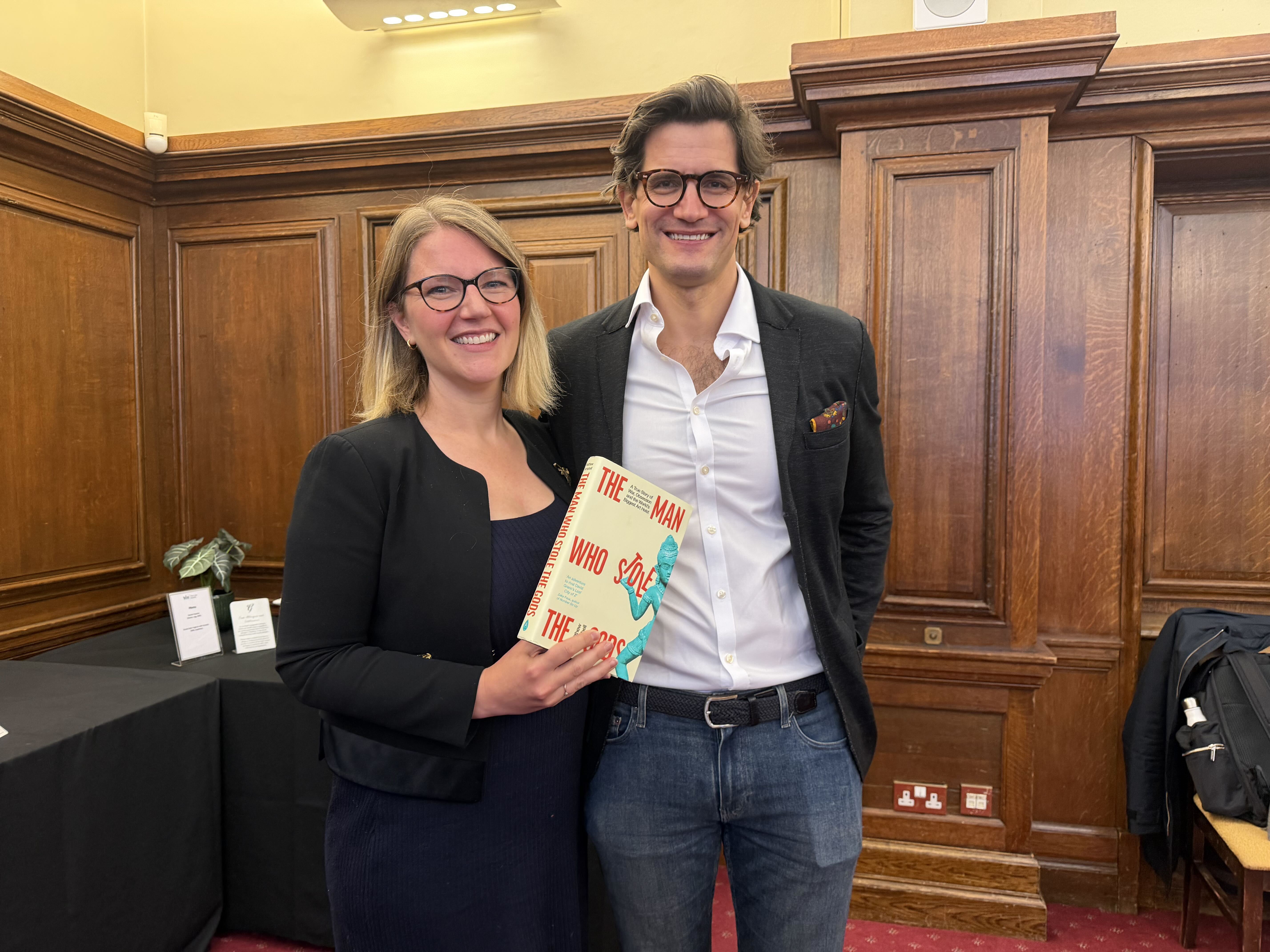
For Atalanta’s final media event of the year, we welcomed Matthew Campbell, award-winning journalist, senior reporter and editor at Bloomberg Businessweek, and author of the recently published The Man Who Stole the Gods. Covering some of today’s biggest cultural flashpoints, including restitution and complicated debates over museum ethics, the conversation at The Law Society ranged from the fall of the Khmer Empire to modern-day law enforcement.
The morning was led by Atalanta’s CEO, Elizabeth Ames, and brought together a group of communications, external relations, and public affairs leaders eager to hear the extraordinary story behind Matthew’s most recent book: how sacred Cambodian masterpieces were turned into luxury assets, and how the art world’s gatekeepers helped make it possible.
The people behind the story: Matthew reflected on the personalities who stayed with him, including Bradley Gordon, the attorney who tracked down the looter at the story's heart. Having come to the subject with no art history background, he described how some of the first people he met were quick to justify what they were doing, a pattern that shaped his reporting.
Law enforcement as the lever: Restitution efforts have gathered pace in the UK and US, and the biggest lever has been law enforcement, using laws against knowingly possessing stolen property to cut through museum reluctance to return artifacts. Matthew described the cat-and-mouse investigations that began in the US around 2010 and 2011, the offer of amnesty in exchange for information, and the difficulty of proving that an object left the ground before 1970, the point at which the UNESCO 1970 Convention on the Means of Prohibiting and Preventing the Illicit Import, Export and Transfer of Ownership of Cultural Property is not enforceable.
Engaging on the ground: Matthew spoke about the reporting challenges of the story, from earning the trust of Cambodian villages to getting billionaire art collectors to talk, and how his approach to communication was grounded in active listening, seeking to understand each person’s perspective in a way that then helped drive the book’s narrative.
A story still unfolding: Restitution is far from a closed chapter. Matthew pointed to the 2023 civil war between the Sudanese army and the Rapid Support Forces (RSF) in Sudan, where the national museum lost a reported 60% of its objects through looting, and to the looting of Baghdad in 2003 as reminders that cultural heritage remains at risk in conflict.
At Atalanta, we believe that convening people from across media, business, policy, and civil society is the best way to understand the world around us and build new working relationships. Stories like this one show why: reputation, ethics, and accountability are never far apart, and organisations need to be ready to meet scrutiny with clarity and credibility.
We thank Matthew for sharing his time and insights, and all our guests for joining us. Matthew’s book is available for purchase here.
See how we help organisations shift narratives and accelerate impact, from navigating scrutiny to communicating with credibility across different audiences, here.